Many people say the disease is incurable, although the Gimme folks showed me a machine that they claim somehow makes the suffering easier to bear:
Sunday, December 14, 2008
I was at the Gimme Coffee roastery today, and was shocked to find two of the employees have a disgusting brown tongue disease. Beware of this; apparently it is highly contagious at roasteries and coffee shops.


Many people say the disease is incurable, although the Gimme folks showed me a machine that they claim somehow makes the suffering easier to bear:
Monday, November 24, 2008
stove top espresso with a portafilter
I've never seen anything like this before... I mean, a stove-top espresso-maker with a portafilter and a steam wand. Interesting!
Tuesday, October 28, 2008
Michelle Campbell
This is Michelle Campbell.
Today was her last day at the SCAA.
She was the Director of Community & Events.
She was the administrator of the US Barista Championship.
She was the administrator of the World Barista Championship.
She was the staff liaison of the Barista Guild of America.
For six years, she was a supporter, cheerleader, advocate, defender, enthusiast, admirer, and crusader for baristas all around the US and around the world.
She was a friend to all baristas.
The specialty coffee community owes her a debt of gratitude.
Thank you for your work, your dedication but most importantly your love.
Best of luck in your future endeavors.
We'll miss you!
We love you Michelle!
Sunday, October 26, 2008
Portafilter Podcast July 2005 - March 2008
It's with greatly mixed feelings that I announce that the Portafilter Podcast is no more.
Over three years, the podcast has been downloaded over 200,000 times (over 2,600 per episode on average), and it's been an unbelievable run.
In the interest of not digging into unnecessary messiness, my co-host and I find ourselves with certain irreconcilable differences, and I am unable to continue the partnership.
I do thank my co-host, Mr. Jay Caragay, for a great series of podcasts, and I wish him well in his continuing endeavors.
A coffee podcast may be reborn in one sense or another sometime in the future, and for now, the podcast RSS feed (via iTunes) will live on, and with 4,000 downloads of old episodes per month right now, I have no intention of pulling them off-line. The blog will continue as well.
Thanks to the throng of devoted listeners. From industry movers-and-shakers to home coffee enthusiasts, my hope from episode one to episode 75 was for the podcast to, in any way, add to your entertainment and coffee experience.
Our email addresses will always remain one way to contact us: nick@murkycoffee.com and jay@jaysshaveice.com.
With that...
...party on.
Wednesday, October 22, 2008
Roast Magazine Roaster of the Year 2008...
Congrats to PT's Coffee and the Coffee Klatch for winning Roast Magazine 2008 Roaster of the Year!!!
Wednesday, October 15, 2008
Got Mojo?
(OK, since I usually don’t drink a lot of non-espresso coffee, maybe that ain’t sayin’ much. But still, the brewed coffee’s been GOOD lately!)
The ExtractMoJo system consists of two parts. The first part is a computer program that quickly and accurately calculates the doses of coffee and water to prepare any size batch at your preferred proportions. The second part is a compact digital refractometer that, along with the software, allows you to determine the strength of your cup (aka, total dissolved solids) and the solubles yield (ie, what percent of the dry coffee went into the brew).
So why is this helpful?
Taste panels over the years have usually found that the best brewed coffee results when your technique is adjusted so that two criteria are met:
(1) 19-21% of the dry coffee mass is extracted into your cup and
(2) the resulting beverage ends up containing somewhere around 1.3-1.5% coffee solids.
It’s interesting to note that it’s NOT ENOUGH simply to start out with the proper proportions of dry coffee and water. It’s also necessary to tweak your temperature, grind, steeping time, and stirring to achieve that 19-21% extraction rate. This can be done by trial and error, for sure, but that can be a fairly lengthy process without experience. ExtractMoJo allows you to zero in on the right technique after only a few test brews.
OF COURSE you still have to adjust the coffee TO YOUR TASTE; no one and no system can decide for you what your coffee should taste like. In particular, the 1.3-1.5% coffee solids is very flexible depending on the coffee and your preference. But this system gets you in a reasonable range much more quickly, and allows you to reproduce your favorite recipes (for different coffees) at another time. And for a shop where many people prepare the coffee, it makes it relatively easy to create objective quality control standards that are verifiable and repeatable.
A side note: the refractometer may help to explain the mystery of why different clover and vac pot stirring techniques have fiercely loyal adherents: up to a point, more stirring results in a bit more thorough extraction, and more extraction changes the flavor. We shall see as people experiment with these tools.
And, with a bunch more development, ExtractMoJo may become be useful for espresso brewing, too (I hope!) Espresso "standards" are hugely variable right now, and it would be great to be able to accurately make strength and solids yield measurements. Not to try and force people to make an arbitrarily "correct espresso," but simply to begin to understand how people are arriving at the particular flavor profile that they prefer. I believe that someday soon this technology will become de rigueur for quality oriented coffee shops.
Tuesday, October 7, 2008
Wednesday, October 1, 2008
Friday, August 22, 2008
Saturday, July 26, 2008
Coffee Labs Roasters, Tarrytown NY
My initial assumption was that the "Lab" in Coffee Labs Roasters referred to some sort of roasting laboratory. And apparently it does. But there's a double meaning: the owners love dogs, particularly chocolate labs. So they run the first dog friendly cafe I've ever seen. Since I frequently travel with my dog, Paris, I was psyched to visit this place.
So I walked in, dog in tow. There were a couple of ceramic Labs guarding the place (that's one in the picture above). After greeting them and a few friendly customers, Paris did what he does best, falling asleep right on the floor:
Going up to the counter, I ordered an espresso from a barista whom I eventually find out is named Maddy. The baristas on duty were Jess, Will, and Maddy:
I suppose that at any committed coffee shop, a customer ordering straight espresso gets the attention of a serious barista. It says, "I appreciate COFFEE," not just flavored milk shakes!" Maddy appeared to prepare my double espresso with extra care, and served it in a ceramic cup. She even offered me a small spoon to stir with. These people WERE committed!
The espresso was GOOD, and not only that, it had the distinctive soulful funk of high-quality Sumatran beans. Maddy confirmed that, and I could tell she appreciated the comment. I'm only speculating, but it must be satisfying to have customers really taste what you're serving.
I struck up a conversation with Jess, and she sensed my enthusiasm about the coffee. She asked me if I wanted to try their decaf espresso. Now decaf is normally something I never order, but I said sure, I'd love to taste it. It was good, too, although characteristically lacking the flavor punch of a regular coffee. So Jess said, "let me pull you our regular espresso blend the way I like it," and she proceeded to tweek her technique on the big (semiauto!) GB5 to get a slooooooow, drip...drip...drip ristretto from the bottomless pf.
This one was terrific. It had all the Sumatra flavor I love, but with bigger body and juicier mouthfeel. It was a joy to drink such quality coffee on the road.
Well done, Coffee Labs!
Tuesday, July 22, 2008
The 2008 WBC Champion... EXPOSED!!!
"I must be honest, things have changed around the apartment since getting back from Copenhagen. I wish I could say that Stephen hasn’t let success go to his head and is the same old lovable guy - but this simply isn’t the case."
More exposé here.
So sad.
Friday, July 18, 2008
More big coffee news
This is what people SHOULD be talking about this week!!!
Another example of how the blogosphere is generally a pretty dumb place (present company included).
Monday, June 30, 2008
Fill in the blank
From today's Washington Post...
What are they talking about? Check it out!
In Tokyo and Paris, you can now spend $5 a glass on _____ selected by a professional _____.
Nothing surprising there, except the beverages being served are ____ -- with various "flavors" supposedly matched to different foods.
_____ from Hawaii, meanwhile, is being sold as "_____" -- at $33.50 for a two-ounce _____.
The push to turn _____ into the new wine is a marketing phenomenon: The _____ industry is engaged in an intense effort to convince Americans that _____ is substantially different from the stuff out of _____.
What are they talking about? Check it out!
Thursday, June 26, 2008
Sunday, June 22, 2008
Somewhat Pretentious Coffee Prediction for 2011
I thought James's coffee predictions for 2008 were very well done. Of course I'm not in James's league, but I do have a coffee prediction to make for oh, about the year 2011.
I find it surprising that many specialty roasters are ultra particular in the way they select coffees, and they're extremely meticulous in the way they roast. But after that...they throw the finest coffees in the world into a valve bag, send them out the door, and simply hope for the best. Sometimes the coffee tastes best on the fourth day, sometimes on the fourteenth. Sometimes, never.
My somewhat pretentious prediction is that cutting-edge roasters, (especially those who run their own local cafes) will soon begin to do better. Starting around 2011, freshly-roasted beans will be transferred into reusable canisters within seconds of leaving the cooling tray. The canisters will be hooked up to a gas-flush system that will promptly remove oxygen and replace it with nitrogen or CO2. The canisters will have one-way valves that may or may not be set up to maintain the contents at slightly elevated pressures (like Illy's 0.5 bar).
Canisters will be stored in inventory areas that are temperature controlled. Considering the high capital costs of setting up a roastery or cafe, having a properly controlled storage area (perhaps the size of a walk-in closet) is a relatively small additional expense.
Cuppers and baristas will be exacting in the way they specify how long and at what pressure their coffees are aged. Each origin and each blend may have its own specification. Some may age for 4-5 days, some for 12-15. Cuppers will argue about this passionately. :-)
At the store level, staff obsessed with serving the best possible coffee will be able to rely on consistent, delicious and optimized flavor profiles. Discerning customers will rave about the beverages. It will all be good. :-)
BTW, if this happens sooner, like in 2009 or 2010, I won't be miffed!
(Perhaps someone can clue me in, I believe 49th Parallel is pursuing at least some of these strategies already. Is there anyone else?)
I find it surprising that many specialty roasters are ultra particular in the way they select coffees, and they're extremely meticulous in the way they roast. But after that...they throw the finest coffees in the world into a valve bag, send them out the door, and simply hope for the best. Sometimes the coffee tastes best on the fourth day, sometimes on the fourteenth. Sometimes, never.
My somewhat pretentious prediction is that cutting-edge roasters, (especially those who run their own local cafes) will soon begin to do better. Starting around 2011, freshly-roasted beans will be transferred into reusable canisters within seconds of leaving the cooling tray. The canisters will be hooked up to a gas-flush system that will promptly remove oxygen and replace it with nitrogen or CO2. The canisters will have one-way valves that may or may not be set up to maintain the contents at slightly elevated pressures (like Illy's 0.5 bar).
Canisters will be stored in inventory areas that are temperature controlled. Considering the high capital costs of setting up a roastery or cafe, having a properly controlled storage area (perhaps the size of a walk-in closet) is a relatively small additional expense.
Cuppers and baristas will be exacting in the way they specify how long and at what pressure their coffees are aged. Each origin and each blend may have its own specification. Some may age for 4-5 days, some for 12-15. Cuppers will argue about this passionately. :-)
At the store level, staff obsessed with serving the best possible coffee will be able to rely on consistent, delicious and optimized flavor profiles. Discerning customers will rave about the beverages. It will all be good. :-)
BTW, if this happens sooner, like in 2009 or 2010, I won't be miffed!
(Perhaps someone can clue me in, I believe 49th Parallel is pursuing at least some of these strategies already. Is there anyone else?)
Friday, June 13, 2008
Exquisitely Fine Coffees

RodLazar.com
It's a satirical take on Third Wave coffee and the people involved, and I've gotta say that it's pretty damn hilarious, as well as being a bit of commentary on how "out there" we coffee-people can get sometimes.
To be clear, though a lot of folks see it completely as a parody of our buddy R. Miguel Meza's project, it's not, though it's certainly one of its "targets." (Oh, and FYI, I had nothing to do with it.) Consider it an opportunity to laugh at ourselves, our obsession with exclusivity, cutting-edge tools and techniques, and how strangely esoteric we can get when it comes to coffee.
I'm just hoping that my Rod Lazar t-shirt arrives here in time for me to be able to wear it in Copenhagen during the World Barista Championship week! I'm looking forward to seeing folks in Denmark, and be sure to check out the official WBC Live Video feed that will appear on www.worldbaristachampionship.com. Congrats to all the national barista champions, and can't wait to meet the new WBC Champ!
Saturday, May 17, 2008
Tim/Trish/Nick WRONG about Wave Theory!
I know the perpetual controversy about coffee wave theory is old news, but I had to mention that we've been mistaken about this. I just bought an excellent CD at Starbucks, where they obviously know what the Second Wave is all about.
Sorry to burst your bubble, Tim, Trish and Nick.
Wednesday, May 7, 2008
I heart Rocky Rhodes
Too bad I can't embed the preview to this TV show, but google this: Peter Perfect, "Wake Up and Smell the Coffee"
You'll see my pal, Rocky Rhodes busting up his "country kitchen" style roastery for a style channel show about redesigning business spaces. Apparently, this aired on May 3. I'm still trying to find it online.
Sunday, April 27, 2008
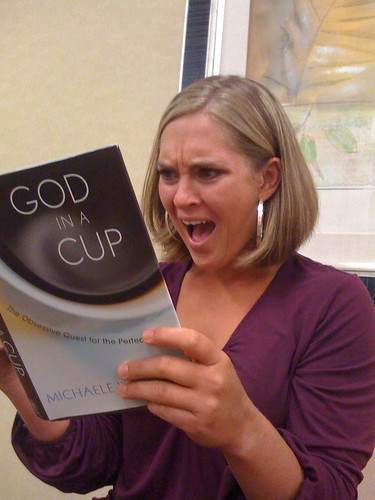
"I don't read books." - a book review.
Today, I tore through God In A Cup in about 3.5 hours, coupled with a beautiful cup (or two) of Kenya Kangocho Peaberry auction lot #4602. Having that coffee today deserves its own blog post... maybe I will some time.
For now, I have to share my thoughts on this book by Michaele Weissman, food-writer and author of a book she almost called, "On The Road With The Coffee Guys." Thank God someone talked her out of it.
Now I have to make a disclaimer: I'm in the book. Michaele wrote an article for the New York Times a couple-or-three years ago, and interviewed me for it. The prologue of the book includes a recounting of my making for her what Michaele says is her first cup of "real coffee," a 12-ounce cappuccino (yes, 12 ounces... it's on the menu... and yes, we have a 6 oz "real" capp too!), and that it sent her "down the rabbit hole into coffee land." What follows, I can only say that I'm deeply humbled and honored to have played the tiniest of roles in.
Michaele spent the next couple of years working on this book, where she travels to locales as exotic as Burundi and Ethiopia, and as familiar as NYC and Los Angeles, to chronicle the personalities and work of the Third Wave coffee professionals. There are, most who have read the book will tell you, four main characters in the book: Peter Giuliano (Counter Culture), Geoff Watts (Intelligentsia), Duane Sorenson (Stumptown) and a coffee known as Hacienda La Esmeralda Special.
The thing that's striking about reading the book, knowing these folks so well, is how much she "gets it." As affable and bright as they come, Michaele is really easy to talk to, and she approaches things with a wonder and twinkle in her eye in a way that I've mentioned more than once that she is like a teacher at Hogwart's, and you could totally see her schooling Harry Potter and his friends in some sort of hocus-pocus of writing and wizardry.
Starting with introductions of the four main characters, God In A Cup takes us along for Michaele's coffee education. From her first trip to origin, observing a Nicaragua Cup of Excellence competition, to not knowing where her passport is in Burundi, to being awestruck by the beauty of Boquete, Panama, to watching the US Western Regional Barista Competition in California, we read page after page of the sorts of stories that we coffee professionals have heard passed around through our oral tradition, but never in print like this.
There's some amazing stuff in here, that had me grinning from ear to ear. Michaele's description of the discussions during the Nicaragua COE that she attended, are the most "I felt like I was there" depiction of those legendary events that I've ever experienced. Her exposition on Peter and Geoff's dealings with coffee producers and a certain cooperative get into more detail than we're ever normally privy to. Her adventures in Africa made me clench my fists in that, "Dang... that sounds so AWESOME!" sort of way.
There is some stuff that will make folks wince, and might be hard to read for some. Personal stuff that you may not have known about certain people. Stories about rivalries and tiffs between folks. Baristas hatin' on other baristas, and looking kinda stupid in the process.
But none of that detracts from the book, and in fact, it made it all the more real to me. Michaele really does "get it," in a way that I've never read before from an "outsider" to the industry.
It will be interesting to see how our industry reacts to this book. Already, there is some degree of jealousy on the part of certain coffee professionals who feel that Peter, Geoff, and Duane are extolled more than they should be. That some coffee professionals are out there proclaiming this and that without acknowledging their predecessors, who actually pioneered the stuff that newer folks are being credited with. I hope people don't get too distracted with their own bullshit to be able to see and read clearly.
However, it begs the question that anyone on the "inside," will likely ask themselves after reading the book, "Will anyone out there really care about this book? Will it be interesting to non-coffee people?"
To me, the fact that there's a big cup of deep, almost black coffee on the cover, is where the answer lies. As coffee professionals, we can wonder whether or not our customers will be able to tell how great a coffee like Esmeralda Especial is. Some won't, frankly. Some may ridicule, and think it's pointless. But some... and I think in both the book's case and in coffee's case more than we'd think... some are going to read this book and be captivated by it.
Congrats Michaele, our friend and our scribe, on your book. Thank you for capturing the moment that is coffee today in such a special way. God In A Cup is available at Amazon.com, and at your local Barnes and Nobles (you can check stock at a store near you).
Wednesday, April 23, 2008
God In A Cup... the BLOG
Check out Michaele Weissman's new book-related blog at: http://michaeleweissmanwrites.com/godinacupofcoffee/
Sunday, April 20, 2008
Novo La Alondra Espresso: first impressions
I recently bought a Novo coffee from Colombia called La Alondra Espresso. Apparently alondra is Spanish for the small bird that Stevie Nicks calls skylark.
This Novo coffee makes an espresso, that is, you could say, a bird of a different feather.
Using my typical 14 gram dose, I mostly pulled shots in the 16-19 gram range. This made the brewing ratio around 75-85%, which is what many people would call a "medium ristretto." La Alondra produces a crema that is extravagantly luxurious, although paradoxically, it doesn't seem to last very long.
The beans are roasted a little darker than many single origin coffees. So the first thing that hit me -- "like a bell through the night" -- was a very pleasing, pungent spiciness: cloves, if you will.
Interestingly, when I went up to 200F from 199F, the spiciness dropped off. The same occurred going down to 198F. So, without getting too Chris Tacy on you*, the temperature seemed fairly critical. Of course, on a different machine, or with a different dose, or with different taste buds, the recommended temp might be quite a bit different.
I liked the bittersweetness of this coffee; a little bit of bitter, a little bit of sweet, a pleasingly sophisticated zing on your palate.
The body was pretty much what you'd expect from a Colombian SOS. A little light, but decent.
This is a nice espresso. It is nice to see people working with many different origins in the pursuit of delicious SO espresso.
* Chris, if you happen to read this, where you been, man? Missin' you....
Sunday, April 13, 2008
Brewing Temperatures, Brewing Ratios
Over on home-barista.com, I posted the results of a little experiment on brewing temperatures and brewing ratios. The article attempts to correlate observations that I previously made here and here.
The HB post has pics and graphs and all that stuff, but perhaps the executive summary is something like this:
Even if your espresso machine delivers perfectly consistent brew water temperatures, the average temperature at which your espresso extracts is much lower for a ristretto than for a "normale." Baristas should take this into account when dialing in coffees to taste.
This may have been obvious, but I'd never seen it mentioned until Scott Rao pointed it out in The Professional Barista's Handbook (which, by the way, Scott recommends that you buy :-)
OK, I recommend that you buy it, too!
The HB post has pics and graphs and all that stuff, but perhaps the executive summary is something like this:
Even if your espresso machine delivers perfectly consistent brew water temperatures, the average temperature at which your espresso extracts is much lower for a ristretto than for a "normale." Baristas should take this into account when dialing in coffees to taste.
This may have been obvious, but I'd never seen it mentioned until Scott Rao pointed it out in The Professional Barista's Handbook (which, by the way, Scott recommends that you buy :-)
OK, I recommend that you buy it, too!
Friday, April 11, 2008
Saturday, April 5, 2008
Got Fresh Beans?
This technique is, of course, heresy; everyone "knows" that you always should grind immediately before brewing!
A big part of the Coffeed discussion revolves around what exactly goes on with the coffee in the interval between roasting and brewing, and how pregrinding makes these things happen much faster (desirable happenings as well as undesirable).
Whether the coffee is preground or not, there are a great number of terms used to describe the changes that occur. You know some of the typical ones: "degassing," "aging," "staling," etc. The variety of terms we use reflects the complexities and controversies that surround the aging of coffee.
In these matters, it's always helpful to see what Illy says in Espresso Coffee: The Science of Quality. And sure enough, he has quite a bit to say. Bear in mind, even though it's edited by the famous Andrea Illy and presented as "Science," everything in the book should be subjected to our own verification.
Now, for the sake of discussion, I'm going to stick my neck out and try to distill this controversial subject into a few oversimplified, over-opinionated and (hopefully) over-the-top paragraphs! Many of you, especially those who are more knowledgeable and more widely read than I, will scream bloody murder at my inevitable blunders. But it's all in the spirit of free and open discourse, no?
The most obvious thing that goes on as beans "age" is degassing: the CO2 produced in the roast process is gradually lost. This is usually considered to be a good thing, because the copious amount of CO2 in very fresh beans makes good extractions problematic, and most people don't enjoy the extra "fizz."
Unfortunately, as CO2 is lost, so are many volatile compounds that give coffee its distinct and delightful aromas. According to Illy, CO2 and volatiles leave the coffee at about the same rate. After 50% of the CO2 has departed, for instance, 50% of the desirable aromas have also left. It appears that this is a win-lose situation: we want to get rid of some CO2, but we inevitably lose some aromas. More on this later.
Another undesirable process that occurs during bean aging is oxidation. Many compounds that are key to imparting fresh coffee aromas and flavors are chemically unstable, and they are very susceptible to oxidation. (This is what Neil Young was referring to when he said, "Rust Never Sleeps.") To the extent that we takes steps to exclude oxygen from our roasted beans in storage, we can avoid a lot of the flavor deterioration.
The aging process includes oil migration, the familiar phenomenon by which coffee oils move from the interior of the roasted beans to the outside, where they can be easily (and undesirably) oxidized. CO2 pressure seems to be the main driving force here.
Another phenomenon, this one unfamiliar, is what Illy describes as the incorporation of volatiles into the structure and oil content of the bean. It means that aromatic volatiles are adsorbed, absorbed or dissolved in various coffee bean structures or substances. This is interesting and desirable, because it tends to save and protect the volatiles from being lost and/or oxidized.
Given all the factors that detract from the quality of our beverage, how can it be that we ever manage to have a good cup? Probably everyone who visits this site has had a least one good coffee in their lifetime. Even Howard Schultz got one when he made his now-famous visit to Cafe Grumpy!
Well, as far as the CO2/volatiles "win-lose" situation is concerned, it's a matter of finding a good compromise. There appears to be plenty of space along the timeline where enough CO2 has departed and enough desirable volatiles are still left to make a great cup. In fact, there may be many points where the balance between the two yields different but still very good results; this happy result may occur surprisingly far down the timeline.
In addition, there are several techniques that attempt to optimize the situation of degassing, volatiles loss and oxidation. It depends on how exquisite a job one wishes to perform. They include:
1. packing the coffee in paper bags and allowing the evolving CO2 to displace oxygen
2. packing the coffee in sealed barrier bags with one-way valves that prevent oxygen re-entry after evolving CO2 has displaced it.
3. flushing oxygen out of one-way-valve-equipped packages with an "inert" gas (CO2 or nitrogen) before sealing.
4. performing the procedure in #3, except with a rigid package that retains about a half bar of overpressure before the one-way valve opens. This strategy, which Illy uses, supposedly keeps more oil and volatiles inside the bean where they are protected from deterioration. After 10-15 days in this moderately pressurized environment the beans are supposed to be better than when they started. Wouldn't it be something if it actually worked as advertised?
5. storage of beans at freezing temperatures greatly slows down all the aging processes. Especially when combined with oxygen exclusion, beans can be kept in "almost new" condition for a much longer interval than normal. Thank you, Mr. Sivetz.
6. use of moisture and/or oxygen scavengers: mysterious little packets that say "Do Not Eat" in English and "Are Americans Stupid Enough to Eat This Packet?" in Chinese. They are available in oxygen-consuming and moisture-removing versions, and they never sleep.
Well, OK, now for a few questions:
1. How many roaster/retailers out there follow Sivetz's recommendation to store their roasted coffee under freezing conditions (with or without removing oxygen first)? If not, why not? You don't think it would be worth it? Why not sell "flash-frozen" coffee beans in a sealed bag with the admonition: "Warning! Allow contents to warm 12 hours at room temperature before opening! Once thawed, store in a cool, dry place outside of the refrigerator."
2. How come some very excellent roasters still sell their retail coffee in plain paper bags, with no moisture/oxygen barrier and no one-way valve? Have they tested it and convinced themselves that it makes no difference?
3. Obviously, Illy Caffe has a proprietary interest in promoting their pressurized storage method, but who has independently tested it with their own high-quality roasted beans?
4. How come I'm asking so many questions, and providing so few answers?
Tuesday, April 1, 2008
Happy Birthday Caragay
Monday, March 31, 2008
Barista shoes at last?
We've had an interesting mix of first-time regional champs and repeat champions at this year's regional barista competition circuit... one more in a couple of weeks and the circle will be complete: the first year with all 10 regions (that's the WHOLE USA) represented by regional barista competitions... and all 10 regional champions at the USBC.
I wanna post a blog-tribute to barista competitions... but I'll wait until after the 2008 NERBC (a.k.a. the "NERD-BC"). See you in Ithaca, NY!
(Coffee themed New Balance shoes (available in Asia only) linked from streething.com)
Sunday, March 30, 2008
Coffee Mysteries
Here's another mystery: the stirring thing. It is often mentioned how full immersion brewing methods -- like french press, vac pot, Aeropress, and the Brewer Formerly Known as 'Clover' -- are extremely sensitive to the way the grounds/water mixture is stirred. A small change in technique seems to have a big effect on the end result. Along these lines, Alistair has been very particular in the way he stirs his Clover brews, and Jaime's the same with his vac pots.
So...do we have to practice stirring plain water for months (as James Freeman reportedly did) before we're "worthy" to buy a $20,000 Japanese syphon brewer? And is it necessary to carve a bamboo stirrer by hand, or will a stainless steel wisk get the job done?
To take this line of questioning a little further, could a robotic stirring mechanism do better (eg, be more accurate, more consistent) than a trained human? Or is there an irreplaceable component of motor control and feedback that the flesh-and-blood Alistair, James and Jaime are utilizing? Zander once told me about the original Clover concept; it included automated grinding and stirring mechanisms, but those complex functions were deemed unnecessary for the specialty market. Hmm...that will change, given the goals of CEC's new owner.
Like the grind fineness problem, I imagine the stirring phenomenon will slowly give up its secrets. Twenty years from now we'll know a lot more about it than we do now. But it will take many careful observations by many hyper-observant baristas before this comes to pass.
Thursday, March 27, 2008
Podcast #75 - "Caragay on a Rampage!!!"
- What Is Peter Giuliano Thinking About Today When Hanging Out With Geoff Watts And What Is HE Thinking About Today?
- SCAA Board of Directors Nominees Marty Curtis and Al Liu,
- and the long-awaited rant from Caragay on the Clover-Starbucks deal. Hope it doesn't disappoint!
1 hour 49 minutes and 27 seconds - MP3 format, 50.2 MB
See the sidebar to the right for more information and how to subscribe or download.
Wednesday, March 26, 2008
A little something we call the "dandelion"
Lo and behold, a resurgence of the low-tech love. I'm not kidding when I say I smelled this coffee coming more that a few months ago. I wandered into a new cute little place up by my house in Seattle called Neptune (Greenwood at 85th) where my good buddy, Reid Hickman, was appearing in a limited engagement.
First time I checked it out, Reid wasn't there, so I asked the girl for a cappuccino. All of a sudden a scrap of paper caught my eye:
"DANDELION COFFEE" was printed in sleek lettering above a list that I recognized as Stumptown's coffee selection. Incorporated into the logo was an image of a fluffy flower shooting out some drops. Hmmmm...intrigued, I asked the girl what the hell.
"Oh it's some kind of blend or something."
I decided to let her off the hook and just ask the owner, who later sidled up to my table to say a friendly howdy. I asked him, was this some kind of good-natured dig on the Clover? He admitted to it with a smirk and a twinkle in his eye, (Dan is kinda like that). Within the same breath he assured me that he desperately wanted a Clover, but could not afford one just yet. This was his way of showcasing the coffees with out it.
I came back later and took some pictures of Reid making a Dandelion...."dandelion" ha! That cracks me up!
Clever...so low-tech and so SO good. You see, Melitta pour-over is my all-time favorite. I make it for myself every morning. Practically every morning I wish I could go to a cafe and get some single origin brewed this way for me. (Sure, almost everyone in Seattle will make you a French Press, but I'm not enamored by the FP.) Now it looks as if my dream will come true in more than one cafe around town.
Just spoke to my old boss, G'pa Babcock at Zoka. He got all excited when I reported that many of "the kids" are going to be working the brew bars soon enough. I reminded him that it is HIS favorite too. (Sometimes you have to remind Jeff about things he already knows).
"Yeah! yeah...we're doing that too! I love it! LOVE it! *heh heh*", he practically shouted back at me with his signature maniacal grin.
Tuesday, March 25, 2008
Ritual Red Flag
I ordered a couple pounds of Ritual's Red Flag espresso which arrived a few days ago. I've been working on it ever since.
Following recent trends, these beans are quite lightly roasted. And they're very small: Ethiopians, I guess, but what do I know?
Well, I know that I'm liking the espresso very much. It is refreshing, sort of like candied lemon peel. Not crazy eye-watering lemon peel, but fruity, and easy-going like a summer lemonade.
I'm reading Ritual's description about "nougaty chocolate, dried cherry and sarsaparilla," and those haven't appeared for me yet, but hopefully they will as I play around.
I also got one of those cool red and white Ritual mugs. What coffee lover's kitchen is complete without one?
Sadly, however, I was unable to order a medium brown Ritual t-shirt, they were out. What gives, guys? :-(
Now if you'll excuse me, I have to get back to my Neti pot. It is, as they say, the shit.
Friday, March 21, 2008
Clover
So instead of a blog post about this week's big story, a blog post about the blog posts about the story.
The coffee-blogosphere's (and online discussion forum) response to this week's big news about Starbucks' acquisition of Coffee Equipment Company, the makes of the Clover 1s coffee brewer, has been really interesting. I've had a lot of stuff going on in my own life these past couple of weeks, much of it not very pleasant... so this story was a welcome diversion. So please excuse me if I come across as a bit full-of-myself here, but I've had a few random thoughts about this:
Starbucks and CoEqCo: we're talking about effing PEOPLE. Zander Nosler is a good guy, and a nice one. He is a flesh-and-blood human being. Howard Schultz is a man, who by all accounts, is a very smart and personable one. For coffee professionals to sit around and trash, insult, and otherwise besmirch these people for the pure joy of typing bullshit online flies in the face of everything that good coffee people stand for. Coffee, at least for me, is really about bringing people together. Act like it's bringing us together... and not just when it's easy.
"It's all about the coffee." I understand that the Clover brewer was marketed to help engage the customers in the varieties of coffee that she or he offered. However, to say "it's all about the coffee" is ridiculous. I've seen at least 100 cups of Clover-brewed coffee sold at coffeeshops, and at least 75-80% of the time, the transaction and service includes the word "Clover" in it, very often with a whole explanation about the machine and what it does. If shops with Clovers were truly "all about the coffee," then you wouldn't ever mention the brewer, other than to say all your coffees are brewed by-the-cup. The Clover is a great machine. It's okay to celebrate the machine as part of the process. "It's all about the coffee" is, in most cases that it's used, just a line.
There's been a healthy dose of backlash, particularly from folks who don't have Clovers in their shops. "Sell out" and other such insults have been lobbed. This is totally ridiculous. CoEqCo is no more "selling out" than you are when you charge money for coffee drinks. I hate to say this, but one of the most common problems with many baristas is that we seem to forget that this is an industry... a business. It's great that we're passionate, but passion without discipline (or in our case, professionalism), has as much real significance as a 12-year-old girl's hysteria over Zac Efron.
About the Clover itself: I've had my own thoughts about the brewer, which I've generally kept to myself. For me, the most compelling aspect of the brewer was always the "fresh-by-the-cup" attribute, and the fact that you could brew pretty much any coffee that you had this way. However, the thing that always bothered me about the Clover was just how touchy the brewer was. "Good cups" and "bad cups." Practiced stirring motions would determine success or failure of that particular cup. It's certainly nothing that good training and practice wouldn't be able to overcome, but it seemed like an almost arbitrarily elevated degree-of-difficulty, with its main value being saving 2-3 minutes of water-grind contact time. That said, a great Clover cup was a great cup any way you slice it!
Finally, one of the most interesting debates that I've come across in the industry involves the question of, "How would specialty coffee in the U.S. and around the world be different if NOT for Starbucks?" Personally, I think that Starbucks' impact is undeniable, and more significant than most admit, much less realize.
Similarly, I think that the Clover brewer's impact in the industry won't be felt for years, when we'll be peering around our manual-pour-brew-bars and syphon-bars and quick-service french press menus and asking ourselves, "How would high-end by-the-cup coffee service be different if NOT for Clover?"
There are more coffeebars out there who don't have Clovers, than who do. That said, Clover's biggest impact won't be the brewer itself, but the way that it inspired and challenged everyone without (and sometimes with) a Clover to capture what Clover does well... but in creative and alternative ways.
Cheers to Zander, Randy, and the whole CoEqCo crew. In the story of specialty coffee, your place in history is secure... and I can't wait to see what you guys come up with next!
Thursday, March 20, 2008
Hey kidz, here's the latest on World Peace
In a previous post, I talked about achieving World Peace by reducing Mazzer grinder waste. Well, here's some more info on that topic.
If you go to Home-Barista.com, you'll find instructions to make a little shnozzola(tm) for your Mazzer. I think it works pretty well and has the potential to save coffee and alleviate the Mazzer Mess.
As always, your feedback is welcome.
Saturday, March 15, 2008
How do they do that?
As you probably know, the beans are roasted to a light brown color, with nary a trace of oil showing. It's a little precarious to keep 'em so light, skirting the edge of acidic green disaster.
But no, at 200F these shots are well balanced, with heavy body, apricot-tangerine overtones and perhaps a hint of roasted hazelnuts. This is very enjoyable espresso.
How do they do that?
Sunday, March 9, 2008
New Grinder Paradigm?
First, here's a summary of the conventional way of espresso grinder management:
1. Based on taste testing, the barista decides on a coffee dose: 7g, 14g, 20g, whatever. Once decided upon, this dose is kept as constant as possible: ideally within a few tenths of a gram.
2. The constant dose may be provided by keeping the doser full and using the vane mechanism to dole out the right amount. Or, since modern baristas prefer to grind fresh for each shot, dose consistency is maintained by eye, by feel, and by using techniques such as "overfill the basket and strike off the excess." An electronic grinder timer can also help to provide approximately the same dose for each grind cycle.
3. The barista adjusts grind fineness to obtain the desired shot volume within a 25-30 second pull (the exact timing depends on individual preference). In tweaking the grind, it is generally assumed that a grinder with infinitely adjustable burrs is required to get the optimum result.
4. As the coffee and environmental conditions change, the barista makes minor grind adjustments to maintain shot timing.
OK, that's the old way of doing things. Here's Philip's new way, as I understand it:
1. The barista decides on an approximate dose, and finds a setting on the Anfim's stepped adjusting collar that gives about the desired shot timing.
2. Using the Anfim's built-in timer, the barista adjusts the amount of time the grinder runs with each button push. This controls the amount of coffee delivered to the doser. Shot time is fine-tuned by changing the dose, not by making grind adjustments!
3. As the coffee and environmental conditions change, the barista makes minor dose adjustments (by twisting the timer knob) to maintain shot timing.
So what's the advantage of this new method? People say various things. In my opinion, for the working barista, it's just a matter of simplicity. Shot running too fast? Twist the knob to dose a little heavier. Shot running too slow? Twist the knob the other way. It is simpler because dose and grind become one integrated process. The old way, there are two separate parameters (dose and grind fineness) that must be managed. Once the barista gets in tune with this method, he or she most likely produces less waste because grinding too much coffee is avoided. Fewer coffee grounds end up dumped into the knock box.
This is pretty simple, but it's also pretty radical. Have you tried it long enough to acclimate to the new method? What do you think?
Notes:
1. Yes, I've always wanted to use the word "paradigm" in the title for a post. So my lifelong dream has now come true.
2. I first heard of this technique from Philip, apologies to anyone who may have proposed it earlier.
3. Apologies also to Philip, et al, if I have the details of this process wrong.
4. Of course, this method can be used on any grinder equipped with a timer adjustable to 1/10th second or less -- not just on an Anfim.
5. Although I have a penchant for bad puns, I go on record noting that I've resisted the temptation to title the post "Searching For a New Grinder Paradigm."
6. Hey Nick, with this, I think I've just about blown my wad.
Saturday, March 8, 2008
The most unpretentious Clover shop
Most of the shops where you've had Clover coffee are probably big names in specialty coffee: Intelly, Stumptown, etc. This was different. Zummo's Cafe (Electric City's retail shop) turned out to be a completely unpretentious neighborhood cafe in a working-class area. The place was un-Bauhaus, un-Deco, and "un-designer," yet very comfortable. And on a Saturday afternoon there was just one barista -- Erin -- on duty. She made coffee, worked the register, did housekeeping, and talked to customers as a one-woman show.
First I ordered a double espresso; Erin prepared it on the big Faema NoStop. Served in a nice ceramic cup, I was initially put off by the huge volume, probably 3.5 oz. It was sort of half way between an espresso and an americano, I guess. But the shot was pleasantly unbitter and I enjoyed slowly sipping on it.
Poking around the shop and reading newspaper clippings on the wall, I slowly learned how this place had come about. Mary Tellie, a former banker, had decided she loved coffee more than banking. So she opened her own roastery. There were numerous pics of Mary, big smile on her face, posing with groups of farmers at origin. Apparently Mary's personal implementation of the direct trade model was at the core of her business plan.
Well, the cup was terrific -- undoubtedly the best one I've ever had at a "neighborhood" shop. I enjoyed nice mellow acidity, a big hit of black tea flavor, and huge orangy fruit.
It's a big coffee world, with plenty of room for both the fancy and the not-so-fancy. I left very happy to have experienced Mary Tellie's simple and heartfelt corner of it.
Wednesday, March 5, 2008
Profilin'
Well, I still haven't delivered on my offer, but I will. The other day in New York we met up in person and talked a bit about the project. James said something like, "pressure profiling is the last frontier in espresso, everything else has been taken care of." But I had to differ.
As I've said (too many) times before, temperature profiling has remained mostly unexplored territory by the current crop of new wave baristas. As soon as I get James's pump built and shipped, I need to design and fabricate my homemade espresso machine that will allow experimentation with flat temperature profiles, declining temperature profiles, etc. Why should Sean L and John E have all the fun?
And Nick, when you asked me many months ago why I didn't ditch the Silvia and get some kind of commercial espresso machine, this is mainly the reason. All the commercial machines are compromised and designed to a price point. That's not to say that they aren't great pieces of equipment. But they are limited in what they can do.
For me, the fun is in the amateur engineering and in discovery. When the machine can accurately profile both temperature and pressure, maybe then we'll be a the last frontier. Maybe....
Tuesday, March 4, 2008
James rocks NYC
On March 2 James Hoffmann and Anette Moldvaer swept into New York and delivered a blow by blow recap of James's triumphant performance at the 2007 World Barista Championship. With a whole lot of help from the folks at Counter Culture Coffee and Ninth Street Espresso, James showed a crowd of hardcore baristas and fascinated newbies just how world-class coffee is done.
Even better for me, though, was meeting James and Anette, and getting the chance to hang out and talk about all manner of stuff. I honestly don't think specialty coffee could find two better ambassadors. Thanks James and Anette, thanks CCC and Ninth Street. It was a great time!
Some pictures of the event are up here.
Sunday, February 24, 2008
Hey Kidz, make your Mazzer dose like an Anfim and achieve World Peace!
People rave about how KLEEN the Anfim doses. They talk about how much less waste they have at the end of a shift, and how the cleanliness enhances their barista experience. Some baristas feel we are closer to achieving World Peace because of the Anfim doser!
Well, if you have a little spare time you can make your Mazzer dose "almost like an Anfim."
Take an index card, or a manila file folder. Cut out a rectangular piece measuring about 1.5" x 5" (4cm x 13cm for you metric types). Roll it into a cylinder, and test fit it into the outlet hole of your Mazzer doser so that it's as tight a fit as possible. Actually, since the outlet hole is a little bigger on the inside than it is at the bottom, it helps to remove the upper star mechanism and fit the tube from the top (removing the guts of the mechanism is a good thing to do anyway, for cleaning purposes).
When you get the fit nice and snug, tape the cylinder to size with a piece of masking tape and then wedge it in there with about 1/2" sticking out the bottom of the doser, sort of like a little snout.
If you get this little tube to fit correctly, it'll stay put through a whole shift and help eliminate that famous Mazzer "leftward heave." This could save a lot of coffee in the course of a day. Of course, nothing is free: it does take a $.01 index card, a piece of masking tape, and 15 minutes.
By the way, in Italy the baristi call this little snout a "shnozz," although the correct term in technical Italian is "shnozzola."
If you're adventurous enough to try that one, there are a couple more things you could do to make your grinder more "Anfim-like."
The next two modifications are designed to "declump" your espresso grounds; declumped grounds extract more evenly, helping to eliminate channeling and related problems.
Go the the hardware store and buy a piece of 0.020" (0.5mm) diameter music wire. Cut a piece about 2.5" (65mm) long. Carefully wedge it between your doser's clear plastic window and the back wall so that it crosses the port coming from the grinding chamber. This will help to break up clumps and make your grounds fluffier. In this picture, you can see I've already removed the damn automatic doser microswitch, which no self-respecting 3W barista has a use for anyway.
The last tweak is strictly for the terminally insane, aka "me." You can make a shnozzola as described above, and equip it with music wire whiskers that automatically sift the grounds as you dose! My mom taught me always to sift the flour when baking a cake, and she knew what she was talking about, believe me.
Using the same 0.020" music wire, tape two or three u-shaped whiskers to the top of the shnozz (I used three, but two might have worked better). Then insert the shnozz as high as possible so that the doser vanes nearly brush the whiskers as you work the doser lever. Clumps will be busted apart as you dose. I swear, it's almost as good as a remote starter on a zero degree day!
Let me know if any of these things work for you. The idea is to make righteously good pours fun and easy!
Well, if you have a little spare time you can make your Mazzer dose "almost like an Anfim."
When you get the fit nice and snug, tape the cylinder to size with a piece of masking tape and then wedge it in there with about 1/2" sticking out the bottom of the doser, sort of like a little snout.
If you get this little tube to fit correctly, it'll stay put through a whole shift and help eliminate that famous Mazzer "leftward heave." This could save a lot of coffee in the course of a day. Of course, nothing is free: it does take a $.01 index card, a piece of masking tape, and 15 minutes.
By the way, in Italy the baristi call this little snout a "shnozz," although the correct term in technical Italian is "shnozzola."
The next two modifications are designed to "declump" your espresso grounds; declumped grounds extract more evenly, helping to eliminate channeling and related problems.
Go the the hardware store and buy a piece of 0.020" (0.5mm) diameter music wire. Cut a piece about 2.5" (65mm) long. Carefully wedge it between your doser's clear plastic window and the back wall so that it crosses the port coming from the grinding chamber. This will help to break up clumps and make your grounds fluffier. In this picture, you can see I've already removed the damn automatic doser microswitch, which no self-respecting 3W barista has a use for anyway.
Let me know if any of these things work for you. The idea is to make righteously good pours fun and easy!
Thursday, February 21, 2008
Throwdown!
Like it or not, in as dynamic a community as the barista community here in the USA, it takes a lot to grab people's attention and get them excited about anything.
This is my love letter to the Latte Art Throwdown.

(As far as I know), the first such Throwdown was during the SCAA Conference weekend in Long Beach, CA last year at the Intelligentsia LA Roasting Works. Put in your $5, one pull, one pour. A team of 2 or 3 judges score the thing, and winner takes all. We must have had at least 30 people (and over a hundred watching) in that first Throwdown, and it was historic. Winner: Kyle Glanville.
The energy and excitement was unmatched. The spontaneity, the international diversity, the passion, and the beer, made for an experience that nobody present will ever forget.
Since then, in the interest of "keeping it fresh," the rules have changed here and there. A party at the Counter Culture Atlanta training center during the Atlanta Coffeefest 2007 inspired a Heather Perry emcee'd redux of the original Throwdown. Winner: "Danger" Dan Griffin.

Seattle Coffeefest birthed two Throwdowns, but in the "BYOV" (Bring Your Own Vessel") version, inspired by a challenge on WBC Champ James Hoffmann's blog. One at Zoka's new roasting facility, the other at Stumptown's Seattle training room. Extra points for a creative vessel, and points for heckling. Winner: Matt Higgins wins with a pig's foot (yes, really)

This past weekend in DC, a new iteration of the Latte Art Throwdown: pour two macchiatos (out of one pitcher), choose the one you like better, and present it for judging. The two judges (in this case, USBC judge Marcus Boni and oft CoE judge and Q-Grader Trish Skeie) confer, and compare it to the best macchiato-art cup, set aside for comparison. The better pour is kept for the next challenger... the losing pour is ceremoniously dumped into the trash.

Mine was dumped. Winner: Amber Sather
The coffee world has never seen anything like it. The Latte Art Throwdowns are the unquestionably most electrifying hour in the entire coffee industry. The screaming. The whooping and hollering. The spontaneity. The spills. The oohs and ahhs. The high-fives and chest-bumping. The bewildered onlookers, usually other coffee professionals, who couldn't fathom anything remotely like that in their particular segment of the industry. The skill. The amazing pours. The shitty pours. The "famous faces." The lesser-known faces. Every part of it... ELECTRIFYING.
How long the thing lasts, remains to be seen. There's something special about each one that makes repeating the same format feel like you're trying to recapture something that's you can't capture, and there are only so many versions of the Throwdown that will keep everyone's attention engaged, in this internet-speed culture that we live in.
Enjoy it while it lasts, y'all. These are special times... don't take it for granted!
In the mean time, baristas around the world... set aside a $5 dollar bill in your wallet. Fold it up right now (fold it once and fold it again) and put it in a special place. That's your Throwdown bill. It's like emergency money, but for Throwdowns only. If you have to lend someone that $5, make sure you tell them, "You'd better pay me back, cuz that's my Throwdown money!"
(photos property of their owners on flickr)
This is my love letter to the Latte Art Throwdown.
(As far as I know), the first such Throwdown was during the SCAA Conference weekend in Long Beach, CA last year at the Intelligentsia LA Roasting Works. Put in your $5, one pull, one pour. A team of 2 or 3 judges score the thing, and winner takes all. We must have had at least 30 people (and over a hundred watching) in that first Throwdown, and it was historic. Winner: Kyle Glanville.
The energy and excitement was unmatched. The spontaneity, the international diversity, the passion, and the beer, made for an experience that nobody present will ever forget.
Since then, in the interest of "keeping it fresh," the rules have changed here and there. A party at the Counter Culture Atlanta training center during the Atlanta Coffeefest 2007 inspired a Heather Perry emcee'd redux of the original Throwdown. Winner: "Danger" Dan Griffin.
Seattle Coffeefest birthed two Throwdowns, but in the "BYOV" (Bring Your Own Vessel") version, inspired by a challenge on WBC Champ James Hoffmann's blog. One at Zoka's new roasting facility, the other at Stumptown's Seattle training room. Extra points for a creative vessel, and points for heckling. Winner: Matt Higgins wins with a pig's foot (yes, really)
This past weekend in DC, a new iteration of the Latte Art Throwdown: pour two macchiatos (out of one pitcher), choose the one you like better, and present it for judging. The two judges (in this case, USBC judge Marcus Boni and oft CoE judge and Q-Grader Trish Skeie) confer, and compare it to the best macchiato-art cup, set aside for comparison. The better pour is kept for the next challenger... the losing pour is ceremoniously dumped into the trash.
Mine was dumped. Winner: Amber Sather
The coffee world has never seen anything like it. The Latte Art Throwdowns are the unquestionably most electrifying hour in the entire coffee industry. The screaming. The whooping and hollering. The spontaneity. The spills. The oohs and ahhs. The high-fives and chest-bumping. The bewildered onlookers, usually other coffee professionals, who couldn't fathom anything remotely like that in their particular segment of the industry. The skill. The amazing pours. The shitty pours. The "famous faces." The lesser-known faces. Every part of it... ELECTRIFYING.
How long the thing lasts, remains to be seen. There's something special about each one that makes repeating the same format feel like you're trying to recapture something that's you can't capture, and there are only so many versions of the Throwdown that will keep everyone's attention engaged, in this internet-speed culture that we live in.
Enjoy it while it lasts, y'all. These are special times... don't take it for granted!
In the mean time, baristas around the world... set aside a $5 dollar bill in your wallet. Fold it up right now (fold it once and fold it again) and put it in a special place. That's your Throwdown bill. It's like emergency money, but for Throwdowns only. If you have to lend someone that $5, make sure you tell them, "You'd better pay me back, cuz that's my Throwdown money!"
(photos property of their owners on flickr)
Sunday, January 27, 2008
Blue Bottle
It's opening weekend for the new Blue Bottle cafe location! It's on the corner of Mint and Jessie (near 5th and Mission) and looks killer. I took my first trip over there yesterday to soak it all in...syphon bar, GB5, pour-over drip bar, cold brew "Japanese style" toddy, La San Marco lever, and little pieces of salty caramel with your coffee. This place is really sexy and was crazy packed! James took care of us and made sure we had a good experience, feeding us shots from the lever machine while we waited for our Syphon. The coolest part for me was waiting in line; I got to eavesdrop on two people chatting about the Clover and other brewing methods in front of us. They're also customers of ours and it was so dope to hear people that weren't baristas totally geeking out on coffee...well, coffee brewing methods. But if Clovers and Halogen bars can grab some initial attention that's all good; it's then the baristas job to direct the focus back to the coffee itself.
Subscribe to:
Posts (Atom)